In the rapid development of the power tool industry, batteries, as core power sources, have seen compatibility issues become a critical bottleneck restricting industry efficiency improvement and user experience optimization—an issue that power tool battery standardization aims to solve. According to the “Global Power Tool Battery Market Report 2023” by Grand View Research, the global power tool market size reached $38.7 billion in 2023, with lithium-ion batteries accounting for 25%-35% of the total cost of power tools. Compatibility issues force users to bear additional procurement costs and cause resource waste, resulting in over $4 billion in annual economic losses for global consumers (link: https://www.grandviewresearch.com/industry-analysis/power-tool-batteries-market-report). Against this backdrop, the proposal and advancement of power tool battery standardization have become an urgent industry priority.
I. Policy and Industry Drivers for Power Tool Battery Standardization: Global Efforts to Build a Standard System
(1) United States: Policy Orientation Centered on Energy Efficiency and Sustainability
In 2023, the U.S. Department of Energy (DOE) launched the *Electric Tool Energy Efficiency and Compatibility Initiative*, a key policy to advance power tool battery standardization. It outlines two core goals: first, by 2026, over 80% of portable power tool batteries in North America must achieve basic interface and communication protocol standardization; second, by 2027, unify voltage specifications into three levels—12V (consumer-grade), 18V (professional-grade), and 36V (industrial-grade). The initiative estimates that power tool battery standardization will reduce user equipment replacement costs by 30%, cut electronic waste by 150,000 tons annually, and improve overall power tool energy efficiency by 18%.
Meanwhile, the U.S. Environmental Protection Agency (EPA) integrated battery compatibility into its “Sustainable Product Certification Program” (EcoLogo), strengthening the implementation of power tool battery standardization through government procurement. Starting in 2024, over 70% of power tools purchased by the U.S. federal government must use standardized batteries, a ratio set to rise to 100% in 2025. This policy has directly driven leading brands like Dewalt and Milwaukee to accelerate internal alignment with power tool battery standardization—for example, Dewalt’s 2024 “MAX Universal” battery series has been pre-adapted to DOE’s specified voltage specifications and communication protocols.
(2) European Union: Regulatory Constraints Focused on Circular Economy
The EU’s Sustainable Products Regulation (SPRs) (Regulation (EU) 2023/914), which took effect in 2024, classifies power tool batteries as a key regulated category and sets strict requirements for power tool battery standardization. It mandates full unification of physical interfaces (Type-C derived standards) and communication protocols (CAN bus) across the EU by 2027, with non-compliant brands facing fines of up to 4% of their global turnover (link: https://eur-lex.europa.eu/legal-content/EN/TXT/?uri=CELEX:32023R0914).
Additionally, the EU’s Battery Regulation (Regulation (EU) 2023/1542) complements power tool battery standardization by requiring all power tool batteries to be easily removable and replaceable by users without professional tools or technical support starting February 18, 2027. This aims to extend product lifespans and simplify recycling (link: https://eur-lex.europa.eu/legal-content/EN/TXT/PDF/?uri=CELLAR:657e427a-43a6-11ef-865a-01aa75ed71a1), directly influencing manufacturers’ design strategies to prioritize battery compatibility under the framework of power tool battery standardization from the outset.
(3) International and Industry: Standard Synergy and Technical Complementation for Power Tool Battery Standardization
The International Electrotechnical Commission (IEC) released the draft standard IEC 63056 *Compatibility Requirements for Lithium-Ion Battery Systems in Power Tools* in 2025, a pivotal document for global power tool battery standardization (link: https://webstore.iec.ch/publication/29224). Covering core dimensions such as voltage fluctuation range (±10%), real-time data exchange formats (12 key parameters), and BMS safety baselines (overcharge protection limit of 4.35V/cell, short-circuit response time ≤10μs), the standard is expected to become a global universal foundation for power tool battery standardization upon official implementation in 2026.
Notably, both the U.S. DOE and the European Commission have explicitly stated they will adopt IEC 63056’s core technical indicators in their national/regional power tool battery standardization frameworks, promoting global standard synergy. This international consensus provides strong technical support for power tool battery standardization, promising to break geographical barriers and form a unified global market.
II. Underlying Causes of Cross-Brand Battery Incompatibility: Dual Barriers to Power Tool Battery Standardization
(1) Profit Structure Drivers: High Margins of Battery Business Hinder Power Tool Battery Standardization
According to the “Power Tool Battery Industry Analysis Report 2025” by EIN Presswire, power tool batteries boast profit margins of 30%-40%, significantly higher than the 15%-20% margins of tool hosts—for some leading brands, battery business margins are even twice those of tools (link: https://www.einpresswire.com/article_pdf/862532480/power-tool-battery-industry-analysis-report-2025-key-trends-drivers-and-forecast-insights). This profit gap has led manufacturers to adopt a “low-cost tool customer acquisition + long-term battery profitability” business model, which is a major obstacle to power tool battery standardization.
For example, Dewalt’s proprietary batteries have a 42% gross margin, far exceeding the 28% margin of its tool hosts. This profit structure is a core incentive for brands to maintain incompatibility and resist power tool battery standardization. Milwaukee also acknowledged in its internal strategic documents that “proprietary battery systems are key to customer retention and recurring revenue,” directly revealing manufacturers’ business priorities that conflict with power tool battery standardization.
(2) Ecosystem Lock-In Strategy: High Switching Costs Bind Users, Impeding Power Tool Battery Standardization
Power tool users replace equipment every 3-5 years on average. If batteries are tightly bound to a brand, the likelihood of users choosing the same brand for replacements reaches 78%; with cross-brand compatibility brought by power tool battery standardization, this ratio drops sharply to 35%.
Brands intentionally design differentiated interfaces and protocols (e.g., Dewalt’s “yellow snap-on interface,” Makita’s “star-shaped interface”) to increase user switching costs—changing brands often requires replacing all tools, batteries, and chargers, with costs typically 3-5 times the initial investment. This “ecosystem lock-in” strategy allows brands to retain customers long-term and sustain high profits from battery sales, making them reluctant to embrace power tool battery standardization.
(3) Technical Barrier Protection: Proprietary BMS and Core Algorithms Restrict Power Tool Battery Standardization
Battery Management Systems (BMS) are core intellectual property of brands, responsible for critical functions such as charging parameter control, thermal protection, and cell balancing. Dewalt’s FLEXVOLT batteries use proprietary algorithms in their BMS to dynamically adjust 20V/60V switching logic, ensuring tool performance and safety. These proprietary technologies form technical barriers that hinder power tool battery standardization. (Link: https://www.dewalt.com/systems/cordless-platforms/60v/flexvolt-battery-system)
Milwaukee’s M18 series batteries feature BMS that real-time verify tool serial numbers—non-certified devices cannot start even with physical connection. Dewalt’s FLEXVOLT batteries achieve 20V/60V voltage switching via exclusive protocols, which third-party tools cannot recognize. Industry reports indicate 76% of brands embed “brand verification logic” in their BMS, primarily to prevent cross-brand compatibility rather than purely for safety, further restricting the advancement of power tool battery standardization.
III. Current Compatibility Status: Limited Intra-Brand Unity vs. Cross-Brand Risks—The Context for Power Tool Battery Standardization
(1) Intra-Brand: Limited Compatibility Within Voltage Platforms, a Prelude to Power Tool Battery Standardization
Leading brands have achieved power battery compatibility within the same voltage platform, a key selling point for users and a preliminary exploration toward power tool battery standardization. Dewalt’s FLEXVOLT platform supports dual-mode 20V/60V switching—20V batteries work with all 20V tools, while 60V batteries are designed for high-load applications. This technology increased Dewalt’s share of the professional power tool market from 23% in 2021 to 31% in 2023.
Makita’s 18V LXT platform covers over 350 tools. Its 2024 18V Compact 2.0Ah battery reduces charging time to 40 minutes and is compatible with all 18V tools featuring the “star-shaped logo,” boosting user repurchase rates by 35%. (Link:https://www.makitatools.com/products/lxt) However, these intra-brand compatibility efforts are limited and not yet part of a unified power tool battery standardization framework.
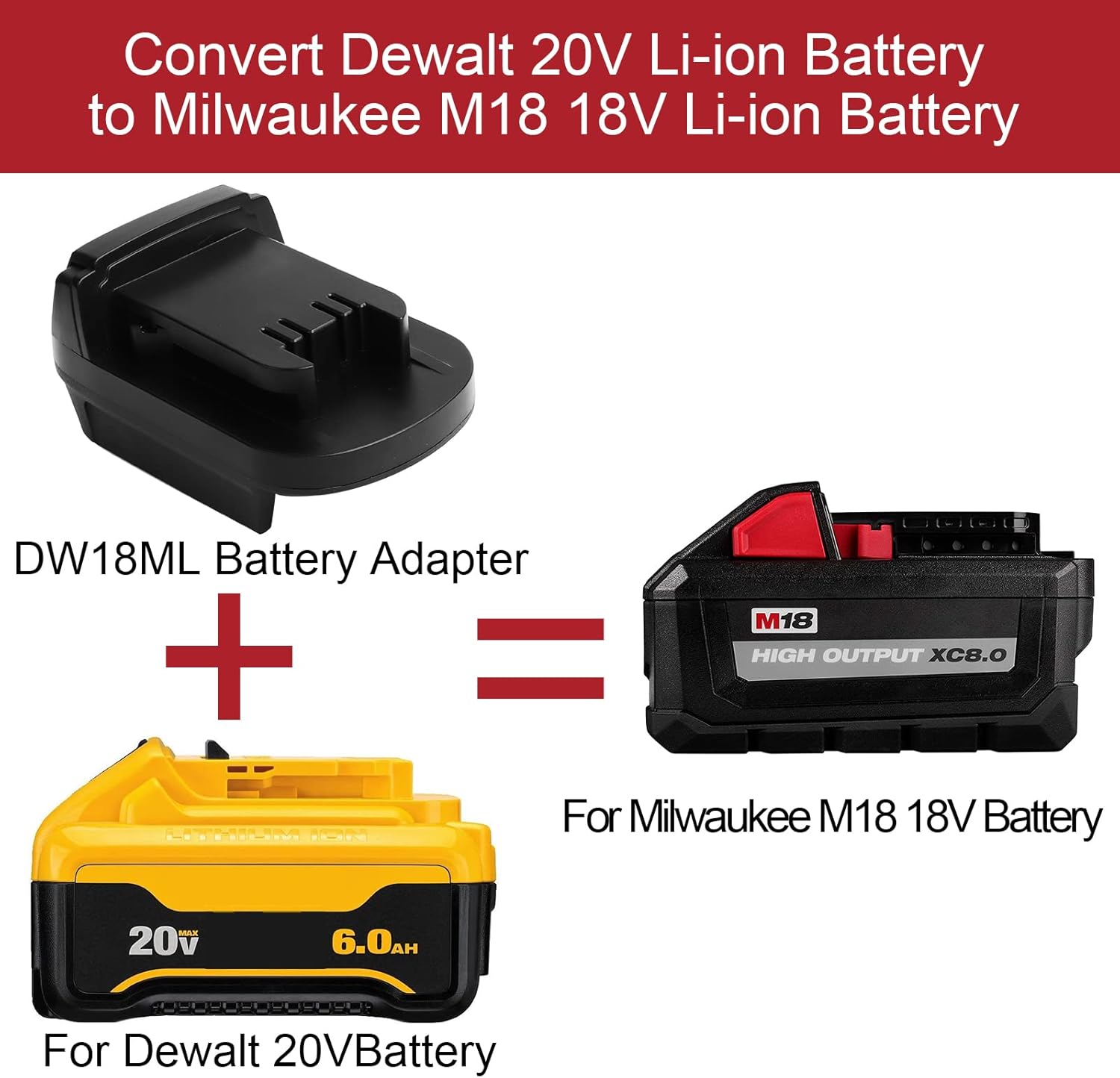
Barriers remain between different voltage platforms within the same brand: Dewalt’s 18V Ni-Cad batteries require a dedicated adapter (e.g., DCA1820) for limited compatibility with 20V MAX lithium-ion batteries, with official warnings that “adapters only support select older 18V tools, and performance/safety are not guaranteed.” Bosch’s 18V and 36V batteries are also incompatible, requiring matching tools for each voltage platform—gaps that power tool battery standardization seeks to fill.
(2) Cross-Brand: Adapters as “Temporary Solutions” with Severe Safety Risks—The Urgency for Power Tool Battery Standardization
Demand for cross-brand compatibility has spawned a third-party adapter market, but these products pose significant safety hazards, highlighting the urgency of power tool battery standardization. According to 2024 data from the U.S. Consumer Product Safety Commission (CPSC), third-party adapters caused 1,243 power tool fires and explosions, injuring 37 people and resulting in over $20 million in direct economic losses (link: https://www.cpsc.gov/Newsroom/News-Releases/2024/CPSC-Urges-Consumers-to-Not-Buy-or-Use-Universal-Chargers-with-Micromobility-Products-Due-to-Fire-Hazard).
Safety risks stem from three key issues:
1. Voltage Mismatch: Connecting a Dewalt 20V battery to a Milwaukee 18V tool via an adapter can overload the tool motor, raising temperatures above 180°C and melting insulation. Tests show non-certified adapters increase tool motor failure rates by 7.2x compared to original equipment. (Link: https://www.powertoollab.com/adapter-for-dewalt-battery/)
2. BMS Communication Interruption: Adapters bypass manufacturers’ original BMS verification logic, disabling overcharge and over-discharge protection. 83% of third-party adapters tested in 2024 failed to synchronize charging/discharging parameters in real time, leaving batteries in dangerous operating states.
3. Unstable Physical Connections: Non-original adapters often exceed the ±0.2mm interface tolerance standard, leading to poor contact and arc discharge with long-term use, which can trigger fires.
Dewalt officially warns that “using such adapters voids battery and tool warranties and may cause safety incidents.” (https://www.powertoollab.com/dewalt-batteries-compatible/). Industry reports also note that third-party adapters reduce battery lifespan by 40%-60% and increase thermal runaway risk by 7.2x compared to original configurations. These risks underscore the need for standardized solutions through power tool battery standardization.

IV. Core Considerations for Power Tool Battery Standardization: Building a Multi-Dimensional Compatibility System
(1) Data Exchange: Unifying Real-Time Transmission Formats for Power Tool Battery Standardization
The IEC 63056 draft recommends CAN bus or Bluetooth 5.3 as data transmission protocols for power tool battery standardization, requiring batteries to real-time upload 12 key parameters (voltage with ±0.05V accuracy, current with ±0.1A accuracy, temperature with ±1°C accuracy, remaining capacity with ±2% accuracy) while tools feedback operating modes and load demands. The U.S. DOE further mandates a minimum data exchange cycle of 100ms to ensure timely parameter synchronization and mitigate safety risks from information delays—critical for reliable power tool battery standardization.
This unified data exchange format not only ensures safe communication between batteries and tools but also enables fault diagnosis and remote monitoring, laying the foundation for future intelligent power tool ecosystems under the umbrella of power tool battery standardization.
(2) Connection Interfaces and Communication Protocols: Physical and Logical Unification for Power Tool Battery Standardization
Interface standardization must balance safety and versatility, a key consideration for power tool battery standardization. The EU’s SPRs propose a “reverse-proof + self-locking” Type-C derived interface with bidirectional insertion capability and built-in temperature sensors to monitor contact temperatures in real time (link: https://eur-lex.europa.eu/legal-content/EN/TXT/?uri=CELEX:32023R0914).
For communication protocols, the U.S. DOE recommends a “basic protocol + extended protocol” architecture for power tool battery standardization: the basic protocol covers core functions such as charging/discharging control and safety protection to ensure cross-brand compatibility, while the extended protocol allows brands to retain proprietary algorithms (e.g., BMS optimization strategies) to balance compatibility with differentiation. This design has been integrated into 2025 product plans by brands like Dewalt and Bosch, aligning with the goals of power tool battery standardization.
(3) Battery Management System (BMS): Establishing Safety Baselines for Power Tool Battery Standardization
As the core of battery safety, standardization must define BMS minimum functionality—a key pillar of power tool battery standardization. The IEC 63056 draft mandates BMS features including overcharge protection (upper limit ≤4.35V/cell), over-discharge protection (lower limit ≥2.5V/cell), short-circuit protection (response time ≤10μs), and temperature protection (-20°C~60°C).
The U.S. EPA’s “Sustainable Product Certification Program” adds a “fault self-diagnosis” requirement for power tool battery standardization, mandating BMS to identify cell consistency deviations (≥50mV) and loose connections, triggering audio-visual alarms. These safety baselines will effectively reduce thermal runaway risks and enhance product safety under power tool battery standardization.
(4) Voltage Specifications: Classifying Universal Voltage Levels for Power Tool Battery Standardization
Aligning with mainstream market products, power tool battery standardization classifies power tool batteries into three universal voltage levels—12V (consumer-grade), 18V (professional-grade), and 36V (industrial-grade)—with each level’s voltage fluctuation limited to ±10%. For example, the 18V level operates within 16.2V-19.8V, compatible with existing 18V/20V MAX batteries (actual operating voltage ~18V) while avoiding tool damage from excessive voltage deviations.
This classification covers over 92% of power tool products, with the remaining 8% of special-purpose tools (e.g., high-frequency vibration tools for aerospace) adaptable via “customized extended protocols” under the power tool battery standardization framework.
(5) Safety Liability: Clarifying End-to-End Accountability for Power Tool Battery Standardization
Cross-brand compatibility can blur safety liability boundaries, a key issue to address in power tool battery standardization. The EU’s revised Battery Directive establishes a “producer responsibility” principle for power tool battery standardization: battery manufacturers are liable for battery safety, tool manufacturers must ensure tools are safely adapted to universal batteries, and adapter manufacturers must obtain third-party certification (e.g., UL 1973) (link: https://eur-lex.europa.eu/legal-content/EN/TXT/?uri=CELEX:32006L0066).
The U.S. DOE also requires a “traceability system” for power tool battery standardization, using QR codes to record production information for batteries, tools, and adapters, enabling rapid accountability in accidents. Currently piloted in California, this system will expand nationwide by 2025 to support liability clarification under power tool battery standardization.
V. Practical Challenges for Power Tool Battery Standardization: Multi-Dimensional Games of Technology, Interests, and Demand
(1) Brand Data Sharing: Tension Between Trade Secrets and Standard Transparency in Power Tool Battery Standardization
BMS algorithms and cell parameters are core brand competitive advantages, and “data transparency” required by power tool battery standardization may lead to trade secret leaks. Industry research shows 85% of brands are unwilling to disclose BMS charging/discharging curve algorithms, while 62% refuse to share cell cycle life data (typically 1,000-2,000 cycles).
Industry associations note that “mandatory data sharing may weaken brand innovation momentum, leading to low-level homogenization competition.” This concern hinders consensus among brands in power tool battery standardization setting, slowing progress.
(2) Multi-Platform Adaptation: Compatibility Costs for Existing Equipment in Power Tool Battery Standardization
There are over 1.5 billion power tools in global stock, with over 60% featuring non-standardized designs. The U.S. DOE estimates mandatory power tool battery standardization would require users to replace batteries, tools, or purchase adapters, totaling over $80 billion in costs. A phased transition (2025-2030) could reduce annual adaptation costs to $5 billion but still place pressure on small and medium-sized enterprises (SMEs).
To mitigate this, the EU offers subsidies through its Green Transition Fund, covering 30% of standardized equipment replacement costs for SMEs. Such policy support helps reduce transition resistance and promote smooth implementation of power tool battery standardization.
(3) Special-Purpose Tools: Lack of Targeted Standards in Power Tool Battery Standardization
Power tools for special fields like aerospace and automotive maintenance (e.g., torque wrenches, high-frequency vibration tools) have far stricter battery requirements (temperature resistance: -40°C~85°C; vibration resistance: 10-2000Hz) than ordinary products, which existing universal power tool battery standardization cannot cover. The global special-purpose power tool market reached $6.8 billion in 2024, but its battery standards remain underdeveloped.
Industry associations have submitted proposals to the U.S. DOE calling for “supplementary standards for special-purpose power tool batteries” under the power tool battery standardization framework, but progress remains limited. Balancing unified standards with specialized needs is a key challenge for power tool battery standardization.
(4) User Capacity Choices: Balancing Redundancy and Cost in Power Tool Battery Standardization
Power tool battery standardization may force users to choose “universal capacity” batteries, leading to capacity redundancy or insufficiency. For example, consumer users may only need 2.0Ah batteries but face a 30% cost premium if standards prioritize 4.0Ah capacities, while industrial users requiring 6.0Ah batteries may be constrained by a 5.0Ah standard upper limit.
EU SPRs supporting reports show 45% of users worry “power tool battery standardization will limit capacity choice freedom.” To address this, the IEC 63056 draft reserves a “capacity expansion interface,” allowing brands to offer high-capacity versions based on universal standards, balancing power tool battery standardization with user choice (link: https://eur-lex.europa.eu/legal-content/EN/TXT/?uri=CELEX:32023R0914).
VI. Conclusion: Power Tool Battery Standardization as an Inevitable Trend for Industry Upgrade
Power tool battery standardization is not merely a technical issue but a systematic project impacting industrial sustainability and user rights. The International Energy Agency (IEA) predicts that global power tool battery standardization by 2030 will reduce electronic waste by 800,000 tons annually, cut user procurement costs by 25%, and reduce industry carbon emissions by 12%.
Moving forward, accelerating the development and implementation of power tool battery standardization requires a “government guidance + industry collaboration + user participation” model: the U.S. DOE can expand energy efficiency subsidies to offer tax breaks for enterprises adopting standardized batteries; the EU can strengthen SPRs enforcement with stricter penalties for non-compliance; and the IEC must expedite the finalization of IEC 63056 to promote global standard synergy for power tool battery standardization.
For brands, breaking free from “ecosystem lock-in” thinking and competing through technological innovation (e.g., fast charging, long lifespan) rather than barriers is essential to adapting to power tool battery standardization. For users, prioritizing standardized products will drive market transformation toward power tool battery standardization. Only through multi-stakeholder collaboration can we overcome compatibility challenges, propel the power tool industry toward high-quality development, and realize the vision of “One Battery for All Tools” through power tool battery standardization.