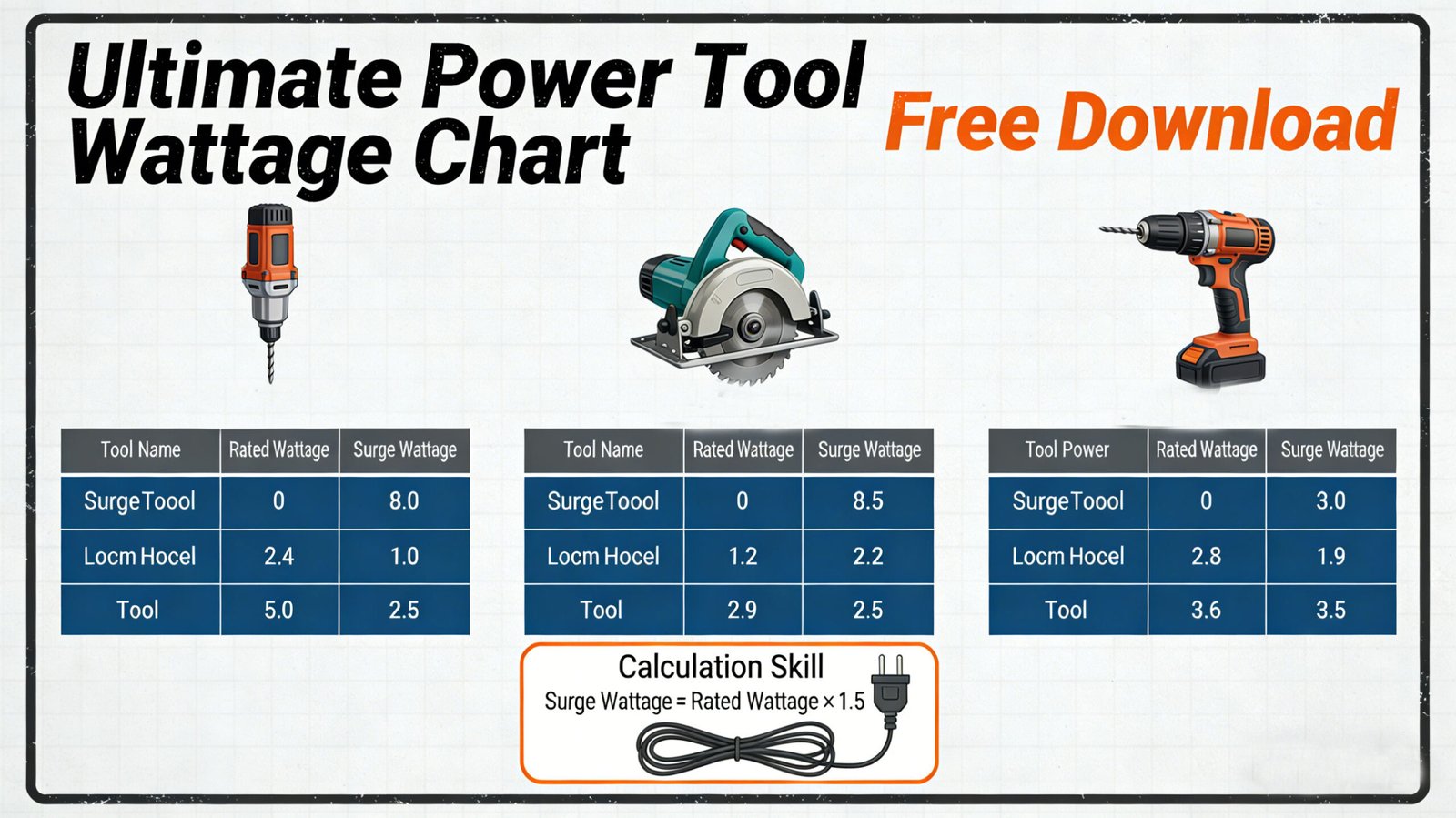
The following wattage values are average estimates for common power tools. Actual wattage may vary by brand, model, and tool size. For precise data, refer to the tool’s user manual or manufacturer’s specifications. Two key wattage metrics are defined below:
Rated (Running) Watts: The continuous power consumption during normal operation.
Surge (Starting) Watts: The additional power required to start motor-driven tools, typically higher than running watts and lasting for a short duration.
Construction & Heavy-Duty Power Tools Wattage Chart
Tool Name
Rated (Running) Watts
Surge (Starting) Watts
Additional Notes
Air Compressor (0.25 HP)
975 W
1,600 W
Small portable model for light tasks
Air Compressor (1.00 HP)
1,600 W
4,500 W
Suitable for professional use
Air Compressor (2.00 HP)
2,800 W
7,700 W
Heavy-duty industrial grade
Concrete Vibrator (0.75 HP)
850 W
1,900 W
For small to medium concrete projects
Concrete Vibrator (2.00 HP)
1,800 W
3,600 W
For large-scale construction
Demolition Hammer (2200 W)
2,200 W
4,400 W
Typical for heavy demolition work
Electric Welder
7,800 W
0 W
No surge wattage required
High-Pressure Washer (1.00 HP)
1,200 W
3,600 W
For cleaning tasks in construction sites
Rebar Cutter (1″)
2,800 W
0 W
Specialized for cutting rebar
Woodworking Power Tools Wattage Chart
Tool Name
Rated (Running) Watts
Surge (Starting) Watts
Additional Notes
Belt Sander
1,200 W
2,400 W
For large surface sanding
Bench Grinder
1,400 W
2,500 W
Common for tool sharpening
Circular Saw (7.25″)
1,400 W
4,200 W
Standard size for woodworking
Disk Sander (9″)
1,200 W
2,600 W
For precision sanding
Jointer / Planer
1,800 W
1,800 W
Consistent power demand
Miter Saw (10″)
1,800 W
1,800 W
Common for angle cuts
Orbital Sander
1,200 W
2,600 W
For smooth surface finishing
Radial Arm Saw
2,000 W
2,000 W
Versatile for various cuts
Table Saw (10″)
1,800 W
2,700 W
Standard home workshop model
Drilling & Fastening Tools Wattage Chart
Tool Name
Rated (Running) Watts
Surge (Starting) Watts
Additional Notes
Electric Drill (Light-Duty)
50-100 W
100-200 W
For drywall, wood, and light materials
Electric Drill (Heavy-Duty)
600 W
900 W
For tough materials like metal
Hammer Drill
1,000 W
3,000 W
For drilling into concrete and masonry
Impact Driver
800-1,500 W
1,600-3,000 W
For driving large screws and bolts
Impact Wrench (1″)
1,200 W
1,400 W
Heavy-duty fastening tasks
Cordless Drill Charger
70 W
80 W
Low power consumption for charging
Cutting & Trimming Tools Wattage Chart
Tool Name
Rated (Running) Watts
Surge (Starting) Watts
Additional Notes
Chain Saw (12″, 1.5 HP)
900 W
0 W
For cutting wood and branches
Jig Saw
300 W
300 W
For curved and intricate cuts
Reciprocating Saw
960 W
960 W
Versatile for demolition and cutting
Hedge Trimmer
300-600 W
0 W
For gardening and landscaping
Nail Gun (Electric)
300-800 W
0 W
For fastener installation
Auxiliary & Specialty Tools Wattage Chart
Tool Name
Rated (Running) Watts
Surge (Starting) Watts
Additional Notes
Drain Cleaner
250 W
0 W
For unclogging drains
Dust Extractor / Vacuum
500-1,500 W
1,000-3,000 W
For workshop cleanup
Heat Gun
1,200-2,000 W
0 W
For paint stripping and heating tasks
Paint Sprayer (Airless, 0.33 HP)
600 W
1,200 W
For efficient painting
Paint Mixer / Stirrer
500-1,000 W
0 W
For mixing paint and other materials
You can download the above power tool wattage chart PDF:
Surge watts are critical when using generators or portable power stations. Ensure your power source can handle the peak surge wattage of the tools you intend to run simultaneously.
Core Calculation Formula: For corded AC power tools, the basic wattage formula is Wattage (W) = Voltage (V) × Amperage (A). This is the fundamental method to calculate the rated power of most corded tools. Example: A heavy-duty electric drill with a rated amperage of 5A (operating at 120V AC) has a rated wattage of 120V × 5A = 600W, which matches the 600W rated wattage listed in the “Drilling & Fastening Tools” section.
Total Wattage Calculation for Multiple Tools: When using multiple tools simultaneously (e.g., with a generator), the total required wattage is calculated as Total Rated Wattage = Sum of Rated Wattages of All Tools. If any tool has a surge wattage, the total required wattage should be Total Required Wattage = Maximum Surge Wattage Among Tools + Sum of Rated Wattages of Other Tools. Example: If you need to run a 10″ Table Saw (rated 1800W, surge 2700W) and an Orbital Sander (rated 1200W, surge 2600W) at the same time, the total required wattage is 2700W (max surge) + 1200W (sander’s rated) = 3900W. This ensures the power source can handle the highest startup surge while supporting the other tool’s continuous operation.
Corded vs. Cordless Tools: Corded tools draw power directly from AC outlets, with wattage calculated as Voltage × Amperage. Cordless tools use battery voltage, and their peak power output is typically lower than corded equivalents (e.g., 18V cordless sanders peak at 90-126 watts).
Motor efficiency affects actual performance. Universal motors in corded tools have 70-85% efficiency, meaning electrical input wattage is higher than mechanical output power.
Continuous vs. Peak Power: Most rated wattages represent continuous power (sustained operation without overheating), while peak power is short-duration maximum output.
Data Sources: Compiled from manufacturer specifications, industry resources, and reputable tool guides.
I am Caio Resende, Welcome to Power Tool Lab! It is a blog dedicated to all polular power tool and accessories including new, best for sale, expert reviews and guides. Whether you are a DIYer, Hobbyist, or professional contractors such as electricians and plumbers, I will provide you all the latest news and professional reviews for all your favorite tools and Brands. Our mission provides great perspective from many different end users.