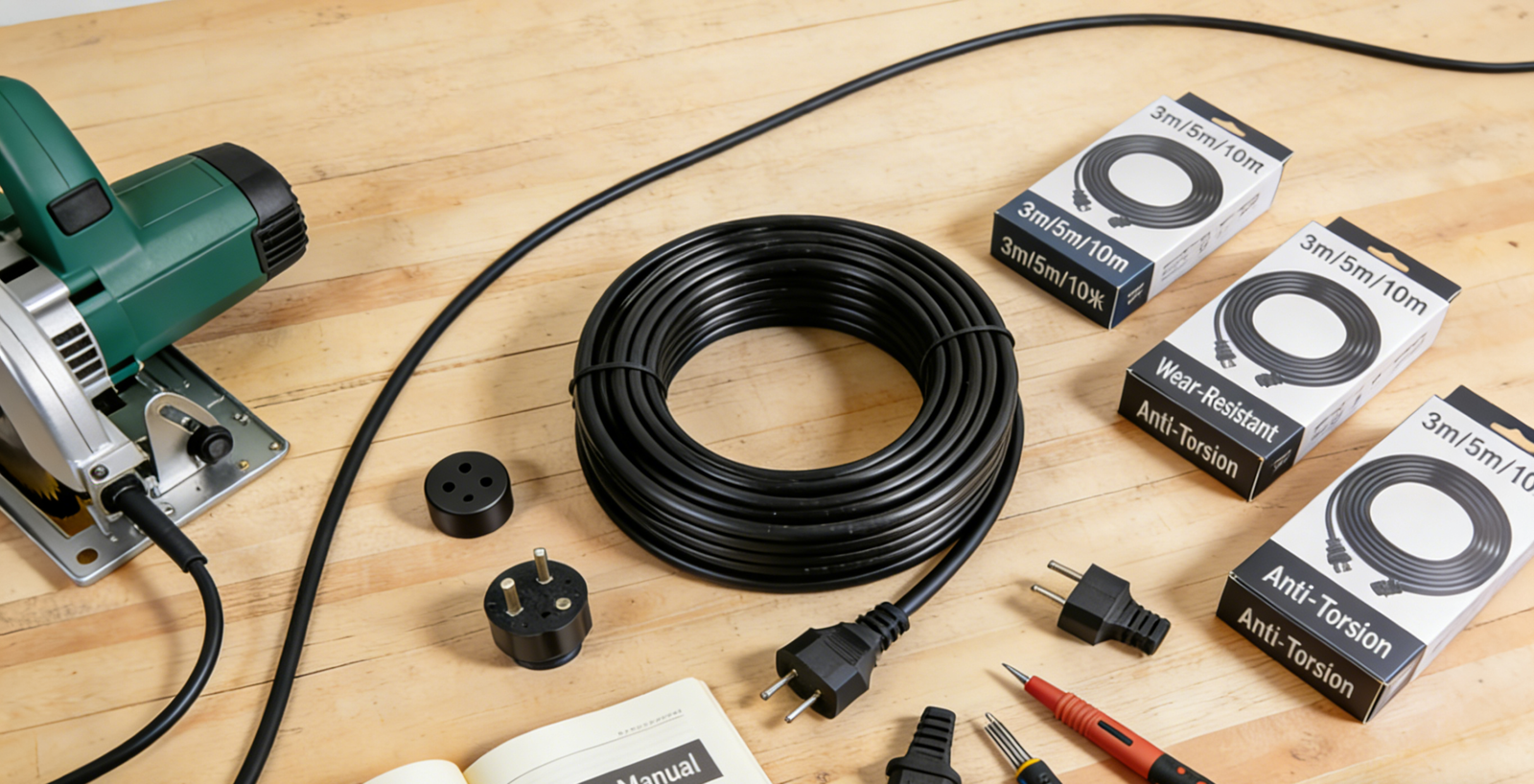
Power cords are the “lifeblood” of corded power tools, responsible for stable power transmission and ensuring operational safety. Yet in practical use, they are often overlooked until malfunctions occur. For professionals and DIY enthusiasts alike, understanding when to replace power cords and how to select the right ones is critical to safeguarding work efficiency, extending tool lifespan, and protecting personal safety. This guide comprehensively outlines the necessity of replacing power cords for power tools, professional selection criteria, and provides a curated list of high-quality replacement options.
Why Replace Power Cords for Power Tools?
The core necessity of replacing power cords for power tools centers on four key dimensions: safety, performance, environmental adaptability, and compliance. Damages such as insulation wear and exposed wires can easily lead to safety hazards like electric shock and short circuits. Oxidation of copper conductors in aging cords causes voltage drops, which impairs tool speed and torque stability while shortening service life. When shifting from indoor to outdoor, low-temperature, or oil-contaminated environments, standard cords fail to meet requirements. Additionally, older cords often do not comply with current U.S. safety standards such as UL and will not pass safety inspections for commercial workplaces, making timely replacement essential.
How to Choose Replacement Power Cords for Power Tools?
Selecting the right replacement power cord requires focusing on core technical parameters, safety certifications, and compatibility with usage scenarios. The following steps provide a professional selection framework:
1. Confirm Compatibility with the Tool
First, ensure the power cord matches the tool’s specifications and U.S. market standards. Check the tool’s user manual or nameplate to confirm key parameters such as the standard 120V voltage and rated current. The replacement cord must meet the tool’s maximum current requirements to avoid overheating from undersized wires or unnecessary costs from oversized ones. Plugs must comply with U.S. NEMA standards; the common NEMA 5-15 three-prong plug (two flat blades and one round ground pin) is compatible with most tools. Brand-specific tools like Milwaukee and Dewalt require power cord sets with dedicated compatible terminals. Never force incompatible products to avoid damaging the tool.
2. Select the Appropriate Wire Gauge
Wire gauge (U.S. standard AWG) determines current-carrying capacity; a lower AWG number indicates a thicker wire and higher current capacity. Choose based on the tool’s power and cord length (longer lengths require thicker wires to reduce voltage drop). Additionally, comply with relevant U.S. 30 CFR §18.35 regulations: current-carrying conductors must be no smaller than 14 AWG, and 14-10 AWG wires require heavy-duty jackets:
- 16 AWG: Suitable for low-power tools (500-800W) such as electric drills and jigsaws. Maximum cord length up to 9 feet (2.7 meters). Recommended wire types: SPT-2 or SVT.
- 14 AWG: Suitable for medium-power tools (800-1500W) such as angle grinders and planers. Maximum usable length up to 15 feet (4.5 meters). Recommended wire types: SJT or SJTO heavy-duty grade.
- 12 AWG and above: Recommended for high-power tools (1500W+) such as electric hammers and concrete cutters. Especially for lengths exceeding 20 feet (6 meters), SJTW or SJTOW outdoor weather-resistant wire is advised.
3. Choose the Right Insulation and Jacket Material
Insulation and jacket materials directly affect the power cord’s durability and environmental adaptability. Common materials include:
- PVC (Polyvinyl Chloride): Cost-effective and lightweight, suitable for indoor DIY scenarios. However, poor low-temperature resistance and prone to hardening.
- Rubber (Neoprene or Silicone): Excellent flexibility, strong oil resistance, and good low-temperature tolerance (-20℃ to 90℃). Suitable for outdoor construction sites, industrial workshops, and low-temperature environments.
- TPE (Thermoplastic Elastomer): High-performance composite material combining the affordability of PVC and the flexibility of rubber. Eco-friendly and wear-resistant, suitable for indoor and moderate outdoor scenarios.
4. Determine the Optimal Length
Select the cord length based on the work range, avoiding excessive length to reduce voltage drop and tangling. A 3-5 meter cord is sufficient for indoor use (e.g., home workshops). For outdoor construction, a 5-10 meter cord provides greater mobility, but a thicker gauge (e.g., 14 AWG instead of 16 AWG) should be chosen for lengths exceeding 6 meters. Avoid daisy-chaining multiple short cords, as this increases resistance and safety risks.
5. Prioritize Safety Features and Certifications
When selecting a power cord, focus on safety features compliant with the U.S. market:
- Strain Relief: Reinforced design at the connection between the cord and tool to prevent wire breakage from repeated bending.
- Double Insulation: Extra insulation layer to reduce electric shock risks.
- Certification Marks: Must have UL (Underwriters Laboratories) certification; additional CSA certification is recommended for Canadian market access. Ensure compliance with U.S. electrical safety standards and avoid uncertified non-standard products.
- High-Quality Plugs: Plugs with tight connections and corrosion-resistant contacts (e.g., silver-plated or gold-plated) to prevent arcing.
6. Consider Special Requirements
For special environments, select power cords with additional features:
- Waterproof/Dustproof: IP-rated power cords for wet or dusty work environments (e.g., outdoor construction in rainy weather).
- Flame Retardancy: Power cords that pass UL VW-1 or FT1 vertical burn tests, suitable for workshops with flammable materials.
- Oil Resistance: Rubber power cords resistant to mineral oil and grease, suitable for auto repair shops.
Recommended Replacement Power Cords for Power Tools
The following products are selected based on technical performance, safety certifications, and user feedback, covering various power levels and usage scenarios. All comply with U.S. safety standards and feature durable materials and reliable designs:
1. Superior Electric EC 163-BB 16/3 9-Foot Replacement Power Cord

- Specifications: 16 AWG 3-conductor, 9 feet (2.7 meters) length, 120V, PVC insulation, with strain relief and cord protector.
- Key Features: Compatible with most mid-range power tools (e.g., Dewalt, Porter-Cable), flexible PVC jacket for indoor use, UL-certified, cost-effective (priced at $16.99).
- Target Users: Home DIY enthusiasts, indoor woodworkers, and users of light-duty tools (electric drills, jigsaws).
2. Milwaukee Tool 22-64-0320 Power Cord Assembly
- Specifications: 16 AWG 3-conductor, 8 feet (2.4 meters) length, 120V, rubber insulation.
- Key Features: Designed exclusively for Milwaukee power tools (e.g., heat guns, impact drivers), oil-resistant and wear-resistant rubber jacket, reinforced plug connection, CE-certified, suitable for industrial use (priced at $23.59).
- Target Users: Professionals in workshops and construction sites, and Milwaukee tool users in need of durable, compatible power cords.
3. Southwire 2589SW0002 12/3 SJTW 50-Foot Outdoor Weather-Resistant Power Cord

- Specifications: 12 AWG 3-conductor, 50 feet (15.2 meters) length, 125V/15A, SJTW weather-resistant rubber jacket, NEMA 5-15 plug.
- Key Features: Well-known U.S.-based brand, UL-certified, with flame-retardant, oil-resistant, and low-temperature-resistant (-40℃) properties. High-purity oxygen-free copper conductors reduce resistance; strain relief design enhances durability. Complies with OSHA workplace safety standards (priced at $49.99).
- Target Users: Users of high-power tools (electric hammers, concrete cutters), outdoor construction workers, and commercial work scenarios requiring long-distance power supply.
4. All-Source APC-JTW 162-8-BL 16/2 8-Foot Power Tool Cord
- Specifications: 16 AWG 2-conductor, 8 feet (2.4 meters) length, 13A, 120V, rubber jacket.
- Key Features: Compatible with large equipment and medium-power tools; flexible rubber for easy storage. Sold in a 4-pack (total price $37.80) for cost efficiency, suitable for commercial use.
- Target Users: Maintenance teams, small workshops, and users needing multiple replacement cords for general-purpose tools.
5. Coleman Cable 02519 14/3 SJTOW 25-Foot Industrial-Grade Power Cord

- Specifications: 14 AWG 3-conductor, 25 feet (7.6 meters) length, 125V/13A, SJTOW rubber jacket, NEMA 5-15 grounded plug.
- Key Features: Professional cable brand under U.S.-based Coleman, dual UL and CSA certification, triple protection (oil-resistant, weather-resistant, flame-retardant). Reinforced plug design prevents loose connections and arcing, suitable for harsh industrial environments (priced at $28.50).
- Target Users: Auto repair shop workers, factory production line personnel, users of medium-power tools (angle grinders, planers), and commercial scenarios requiring oil-resistant and weather-resistant cables.
Conclusion
Replacing power cords for power tools is not just a maintenance task but a critical investment in safety and efficiency. By recognizing the signs that require replacement (damage, performance issues, environmental changes) and following professional selection criteria (compatibility, gauge, material, safety certifications), you can ensure your tools operate reliably and safely. The recommended products above cover a range of needs, from home DIY to industrial use—choose the one that best matches your tool specifications and work environment. Remember, a high-quality power cord extends not only the life of your tools but also protects your most valuable asset: your safety.