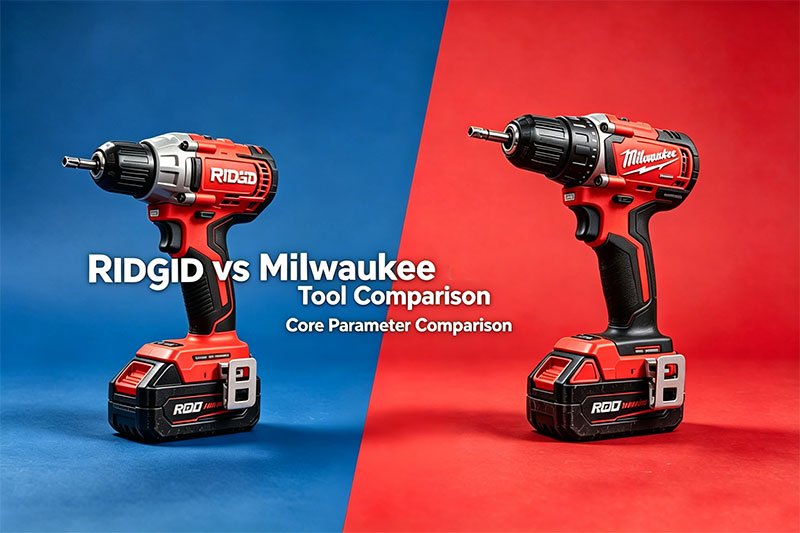
RIDGID and Milwaukee are two of the most respected names in professional power tools, but they are built for slightly different buyers. RIDGID is known for contractor-grade durability, strong value, and its Lifetime Service Agreement, while Milwaukee is widely viewed as the premium benchmark for performance, innovation, and battery ecosystem depth.
If you are deciding between RIDGID vs Milwaukee, the real question is not just which brand is better overall. It is which brand is better for your trade, your budget, and your long-term ownership needs.
Quick answer: Choose RIDGID if you want strong professional tools, better pricing, and long-term warranty value. Choose Milwaukee if you want the highest performance, the broadest platform, and the best fit for heavy daily trade use.
Quick Verdict: RIDGID vs Milwaukee
RIDGID and Milwaukee are both serious professional brands, but they win in different ways.
- Milwaukee is better overall if you want maximum power, runtime, ecosystem depth, and premium jobsite performance.
- RIDGID is better overall if you want strong professional-grade tools at a lower price and care about long-term ownership value.
Bottom line: Milwaukee wins on performance and ecosystem. RIDGID wins on value and warranty.
Brand Overview
RIDGID: contractor-grade tools built for value and service
RIDGID is an American brand founded in 1923 and best known for its deep roots in plumbing and pipe-related tools. Over time, it expanded into cordless power tools, but its strongest reputation remains in specialty trade equipment such as pipe wrenches, press tools, drain cleaners, and inspection systems.
What makes RIDGID stand out is its combination of professional-grade construction and long-term ownership support. For many buyers, the biggest advantage is the Lifetime Service Agreement, which can significantly reduce repair and replacement costs over time.
- Excellent value for professional users
- Strong reputation in plumbing and HVAC
- Lifetime Service Agreement on qualifying tools
- Durable build quality
- Strong specialty tool lineup
Weaknesses: less aggressive innovation than Milwaukee, not as strong in extreme high-performance categories, and a cordless ecosystem that is solid but not as deep.
Milwaukee: the premium standard for professional trades
Milwaukee was founded in 1924 and has become one of the most influential names in cordless power tools. It is widely respected across construction, electrical, plumbing, HVAC, mechanical, and industrial trades.
Milwaukee’s biggest strength is its ecosystem. The M12 and M18 platforms offer a huge range of tools, batteries, and specialty products. Its FUEL line is especially well known for pairing brushless motor technology, advanced battery systems, and smart electronics to deliver top-tier performance.
- Industry-leading performance
- Excellent battery ecosystem
- Broad tool selection across many trades
- Strong durability in harsh jobsite conditions
- High resale value and brand loyalty
- Strong innovation in cordless technology
Weaknesses: higher price point, and warranty coverage is solid but not comparable to RIDGID’s lifetime service model.
RIDGID vs Milwaukee Comparison Chart
| Category | RIDGID | Milwaukee |
|---|---|---|
| Brand Positioning | Contractor-grade value brand | Premium industrial-grade brand |
| Best For | Plumbing, HVAC, value-focused pros | Full-time trades, demanding jobsite use |
| Price | Lower | Higher |
| Warranty | Lifetime Service Agreement on qualifying tools | Standard limited warranty |
| Battery Platform | 18V ecosystem | M12 and M18 ecosystems |
| Performance | Strong and practical | Best-in-class overall |
| Durability | Tough and dependable | Extremely rugged and refined |
| Innovation | Solid, but slower | Industry-leading |
| Specialty Tools | Excellent for plumbing-related categories | Extremely broad across all trades |
| Overall Value | Excellent | Premium but expensive |
Milwaukee 12V Drill 2401-20 vs RIDGID R860012
If you are comparing these two compact drills, the key question is not just which one has more power. It is which one gives you the best balance of size, torque, speed control, and everyday drilling performance. Milwaukee’s 2401-20 belongs to the M12 platform and is designed for compact professional use, while RIDGID’s R860012 is a more value-driven 18V drill aimed at homeowners and contractors who want practical performance without paying a premium.
In real-world use, Milwaukee usually feels more compact and easier to handle in tight spaces, while RIDGID generally offers more torque potential thanks to its 18V platform. If you already own M12 batteries, Milwaukee becomes more compelling. If you want a more affordable general-purpose drill with stronger raw power potential, RIDGID is often the smarter buy.
| Parameter | Milwaukee 2401-20 | RIDGID R860012 |
|---|---|---|
| Voltage | 12V | 18V |
| Max Rotational Speed | 500 RPM | 0-500 / 0-1800 RPM (2-speed) |
| Max Torque | 175 in-lbs | 525 in-lbs |
| Chuck Size | 1/4″ Hex | 1/2″ Single Sleeve Ratcheting |
| Drilling Capacity (Wood) | 6.35 mm | 1/2″ |
| Drilling Capacity (Metal) | 1/4″ | 1/2″ |
| Weight | Lightweight Compact | 2.8 lbs |
| Motor Type | Standard Brushed | Standard Brushed |
| Warranty | Standard Manufacturer Warranty | Not eligible for Lifetime Service Agreement |
| Rating | 4.7/5 Stars (3,012 Reviews) | 4.1/5 Stars (28 Reviews) |
Verdict: Choose Milwaukee 2401-20 if compact size, light handling, and M12 compatibility matter most. Choose RIDGID R860012 if you want a more affordable drill with stronger 18V-style general-purpose capability.
Milwaukee 2674-22C vs RIDGID PEX One
This comparison is most relevant for plumbing professionals who need a battery-powered short-throw press tool for PEX and press-fit work. Milwaukee’s 2674-22C is built for premium trade use and is widely associated with strong jobsite adoption. RIDGID’s PEX One is a specialized plumbing tool that appeals to buyers who want purpose-built press performance and better long-term service value.
When choosing between them, the most important factors are press force, stroke length, cycle speed, jaw compatibility, calibration interval, and how often the tool will be used on the job. Milwaukee usually has the edge in ecosystem depth and premium execution. RIDGID often stands out for ownership value and plumbing-focused practicality.
| Core Parameter | Milwaukee 2674-22C | RIDGID PEX-One 56638 |
|---|---|---|
| Voltage | 18V | 12V |
| Compatible Pipe Size | 3/8″ – 1″ PEX | 1/2″ – 1″ PEX |
| Cycle Time | 3 Seconds | ~5 Seconds |
| Weight | 4.8 lbs | 5 lbs (Tool Only) / 5.9 lbs (With Battery & Dies) |
| Length | 13.5″ | 16.5″ |
| Operation | One-handed, Auto-Cycle | One-handed Thumb Lever |
| Service Calibration Interval | No Calibration Required | 20,000 Cycles |
| Single Charge Performance | High Volume | 150+ Crimps |
| Special Feature | 40% Faster Press, Spring-loaded Jaws | LED Light for Low-Light Work |
| Warranty | 5yr Tool / 3yr Battery / 2yr Jaws | Full Lifetime Warranty |
Verdict: Choose Milwaukee 2674-22C if you want a premium press tool platform with stronger ecosystem depth and frequent jobsite use. Choose RIDGID PEX One if you want a dedicated plumbing tool with better value and strong service support.
Milwaukee Cordless Vacuum M18 vs RIDGID R01601B
For cordless vacuums, the decision usually comes down to suction performance, airflow, battery compatibility, dustbin capacity, and how the vacuum fits into a broader jobsite workflow. Milwaukee’s M18 cordless vacuum is designed for users already invested in the M18 platform, while RIDGID’s R01601B is generally the more practical, value-driven option for jobsite cleanup and general-purpose use.
Milwaukee tends to appeal to professionals who want a cordless vacuum that feels integrated into a premium battery ecosystem. RIDGID usually appeals to contractors and DIY users who care more about utility per dollar, everyday cleanup convenience, and a simpler ownership experience.
| Core Parameter | Milwaukee M18 Aftermarket Blower | RIDGID R01601B |
|---|---|---|
| Voltage | 18V (M18 Battery Compatible) | 18V |
| Motor Type | Brushless | Brushless |
| Max Air Speed | Up to 180 MPH | 130 MPH |
| Max Air Volume (CFM) | 100 CFM | 510 CFM |
| Speed Settings | 6 Adjustable Speeds | Multi-speed |
| Function | 2-in-1 (Blower / Vacuum) | Professional Leaf Blower |
| Compatibility | Fits All M18 Lithium Batteries | Fits All RIDGID 18V Batteries |
| Extra Feature | Low-Voltage Protection, Multiple Accessories | Compact & Lightweight Design |
Verdict: Choose Milwaukee M18 if you already own M18 batteries and want a more seamless premium cordless setup. Choose RIDGID R01601B if you want better value and a more practical everyday cleanup tool.
Milwaukee Impact Driver M18 FUEL vs RIDGID R860021B
This is one of the clearest performance-versus-value comparisons in the entire article. Milwaukee’s M18 FUEL impact driver is built for elite torque delivery, runtime efficiency, and demanding trade use. RIDGID’s R860021B is a more value-focused impact driver that still delivers strong practical performance for everyday fastening, renovation work, and general contractor use.
If you want the strongest overall impact driver experience, Milwaukee is usually the benchmark. If you want a dependable tool at a lower price point, RIDGID offers a very attractive value proposition. The right choice depends on whether you prioritize top-end performance or long-term cost efficiency.
| Core Parameter | Milwaukee 2953-20 | RIDGID R860021B |
|---|---|---|
| Voltage | 18V | 18V |
| Motor Type | POWERSTATE Brushless | Brushed Motor |
| Max Torque | 2000 in-lbs | 1850 in-lbs |
| Max Rotational Speed | 3900 RPM | 2800 RPM |
| IPM (Impacts Per Minute) | 4400 IPM | 3600 BPM |
| Chuck Type | 1/4″ Hex Quick Change | 1/4″ Hex Quick-Eject |
| Control Mode | 4-Mode Drive Control | Variable Speed Trigger |
| Weight | 2.24 lbs | 2.65 lbs |
| Extra Feature | Tri-LED Work Light, Smooth Trigger Control | LED Light, Ergonomic Standable Design |
| Warranty | 5 Year Limited Warranty | Eligible for Lifetime Service Agreement |
| Rating | 4.7/5 Stars (2,446 Reviews) | Professional Grade User Rating |
Verdict: Choose Milwaukee M18 FUEL if you want top-tier fastening power and the best overall impact driver platform. Choose RIDGID R860021B if you want strong everyday performance with better price-to-performance value.
Warranty and Ownership Cost: one of RIDGID’s biggest advantages
One of the strongest reasons buyers choose RIDGID over Milwaukee is long-term ownership value. RIDGID’s Lifetime Service Agreement can significantly reduce repair-related expenses on qualifying tools, batteries, and chargers. For users who want to lower lifetime ownership cost, that is a major advantage.
Milwaukee’s warranty coverage is solid and appropriate for a premium brand, but it does not offer the same lifetime service model as RIDGID. For professionals who want to reduce repair and replacement cost over time, RIDGID has a clear edge.
- RIDGID is better if you care about: long-term repair value, ownership cost control, and minimizing downtime expenses.
- Milwaukee is better if you care about: premium engineering, top-level performance, and ecosystem consistency.
Battery Ecosystem and Platform Depth
For cordless tools, the platform is often as important as the tool itself. Once you invest in batteries and chargers, you are usually locked into that ecosystem for years.
RIDGID’s 18V system is practical and cost-effective, especially for buyers who want dependable tools without overspending. Milwaukee, however, offers one of the most complete cordless ecosystems in the market, especially with its M12 and M18 platforms.
- RIDGID ecosystem strengths: practical, affordable, and strong enough for most contractor applications.
- Milwaukee ecosystem strengths: broader tool coverage, more specialty options, and better long-term flexibility for serious trades.
Buying advice: If you already own batteries, stay within the platform unless there is a strong reason to switch. If you are starting from zero, Milwaukee offers the deeper ecosystem, while RIDGID offers better value.
Final Verdict: RIDGID vs Milwaukee
RIDGID and Milwaukee are both excellent brands, but they are built for different buyers.
RIDGID offers stronger value if you want contractor-grade tools, lower upfront pricing, and long-term service protection—especially if you work in plumbing, HVAC, or similar service trades.
Milwaukee offers better performance if you want the strongest overall cordless platform, the best power output, and a premium tool ecosystem built for demanding professional use.
Value summary:
- RIDGID = value, warranty, and trade-specific practicality
- Milwaukee = performance, innovation, and ecosystem power
For most buyers, the best choice depends less on brand loyalty and more on how the tools will actually be used. If your priority is long-term cost efficiency and practical trade tools, RIDGID is the smarter buy. If your priority is maximum performance and ecosystem depth, Milwaukee is worth the premium.