12V batteries to 24V is one of the most common battery wiring questions for RV systems, solar storage, marine power, backup power, and industrial DC applications. If you need to build a stable 24V battery bank from 12V batteries, the core principle is simple: series wiring increases voltage, while parallel wiring increases capacity.
This guide explains how to connect 2, 4, 6, or 8 x 12V batteries to make 24V, what gauge wire to use, and what safety rules you should follow when wiring a 24V battery bank.
Quick Answer: 12V Batteries to 24V Wiring Rule
If you want to build a 24V system from 12V batteries, the wiring logic is straightforward:
- 2 x 12V batteries in series = 24V
- 4 x 12V batteries = two 24V strings in parallel
- 6 x 12V batteries = three 24V strings in parallel
- 8 x 12V batteries = four 24V strings in parallel
Key principle: series connection increases voltage, while parallel connection increases capacity.
A 24V battery bank should always be built by first creating identical 24V series strings from pairs of 12V batteries, then connecting those strings in parallel if more capacity is needed.
Series vs Parallel Battery Wiring
Series Connection
When batteries are connected in series:
- Voltage adds up
- Capacity remains the same
- Current output does not increase
Example: 2 x 12V batteries in series = 24V. The capacity remains equal to one battery.
Parallel Connection
When batteries are connected in parallel:
- Voltage stays the same
- Capacity increases
- Runtime becomes longer
Example: 2 x 24V strings in parallel = a 24V system with more capacity.
Why This Matters
To build a stable 24V battery bank, all parallel strings should be matched as closely as possible in:
- Voltage
- Capacity
- Battery type
- Age and state of health
Mismatched battery banks can lead to imbalance, poor charging performance, overheating, and premature battery failure.
How to Connect 2 * 12V Batteries to Make 24V
This is the simplest way to create a 24V battery bank from 12V batteries.
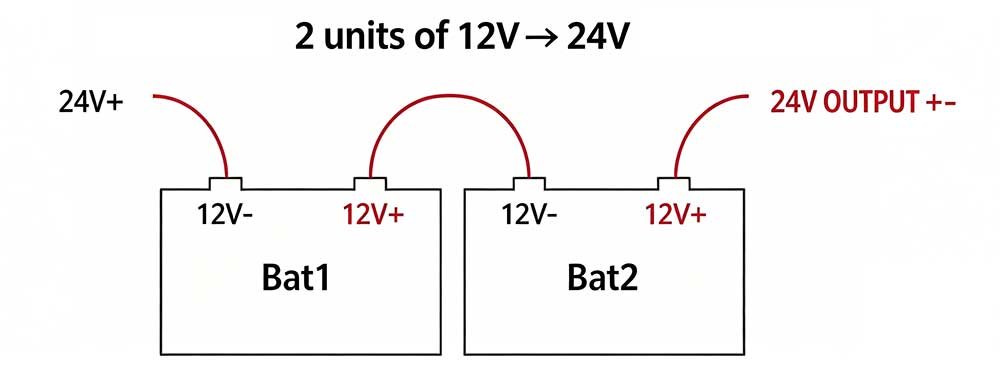
Wiring Method
- Connect Battery 1 negative (-) to Battery 2 positive (+)
- The remaining free terminals become the output:
- Battery 1 positive (+) = 24V positive
- Battery 2 negative (-) = 24V negative
Result
- Output voltage: 24V
- Total capacity: equal to one battery
- Best for: small 24V loads, DC pumps, monitoring systems, compact inverters
This is a pure series connection. The two 12V batteries act as one 24V battery bank.
How to Connect 4 * 12V Batteries to Make 24V
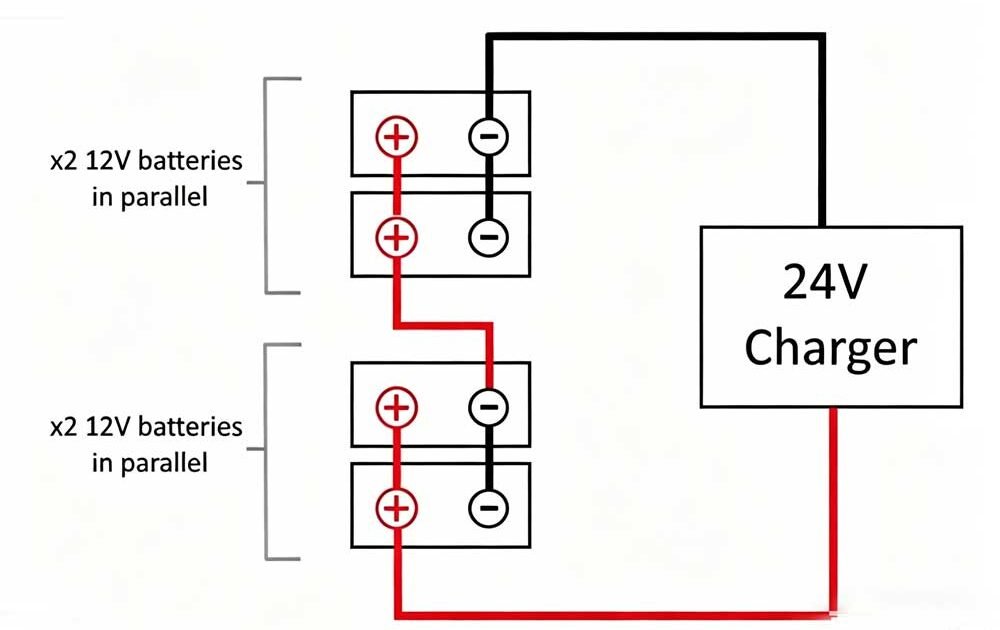
With four 12V batteries, the correct method is to create two separate 24V strings first, then connect those strings in parallel.
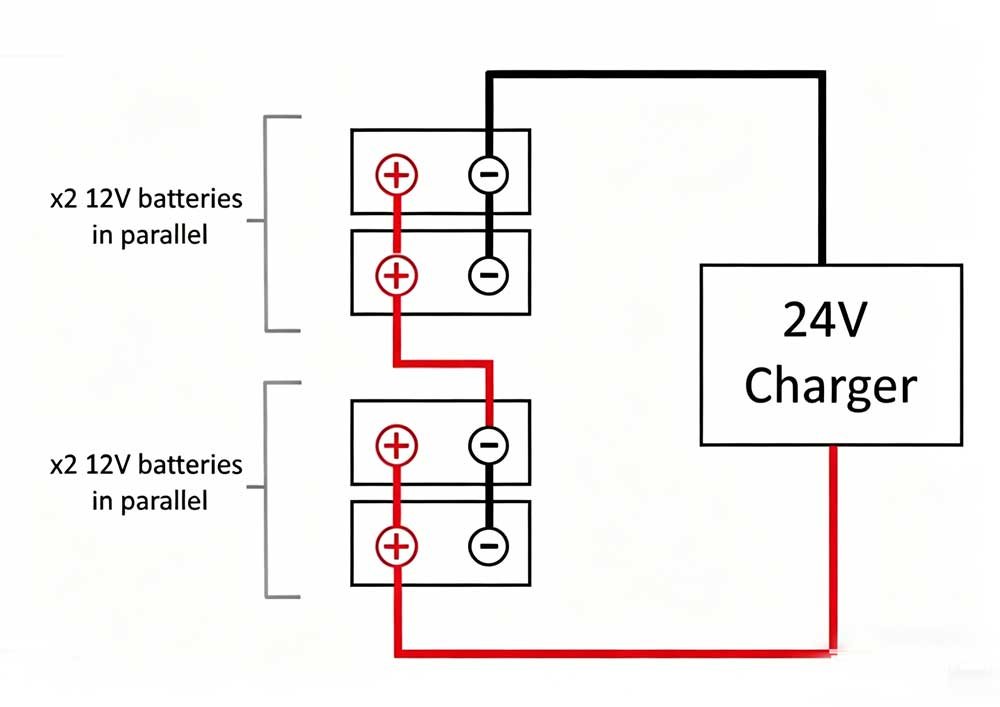
Wiring Method
- String A: Battery 1 + Battery 2 in series
- String B: Battery 3 + Battery 4 in series
- Connect String A positive to String B positive
- Connect String A negative to String B negative
Result
- Output voltage: 24V
- Total capacity: doubled compared with one string
- Best for: solar storage, larger RV systems, longer backup runtime, medium-load inverter systems
Professional Note
For best balance, the two parallel strings should have equal cable length, equal cable gauge, equal battery state of charge, and similar battery age and chemistry. This improves current sharing and reduces circulating current between strings.
How to Connect 6 * 12V Batteries to Make 24V
Six 12V batteries can be arranged as three identical 24V battery strings in parallel.
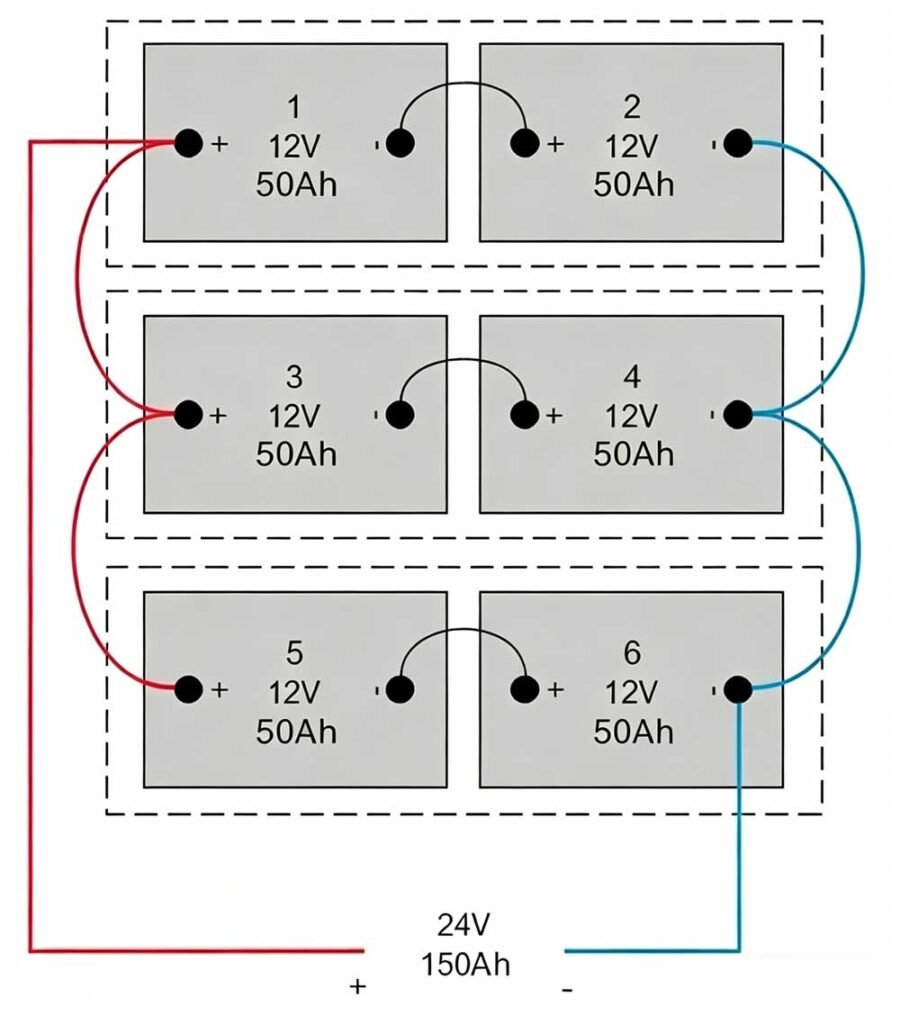
Wiring Method
- String 1: Battery 1 + Battery 2 in series
- String 2: Battery 3 + Battery 4 in series
- String 3: Battery 5 + Battery 6 in series
- Connect all positive outputs together
- Connect all negative outputs together
Result
- Output voltage: 24V
- Total capacity: approximately 3 times a single 24V string
- Best for: off-grid solar, telecom backup, long-duration battery banks, industrial DC systems
Engineering Note
For multi-string battery banks, a busbar-based layout is recommended because it improves system symmetry, reduces connection resistance, and simplifies maintenance.
How to Connect 8 * 12V Batteries to Make 24V
Eight 12V batteries are typically configured as four 24V series strings in parallel.
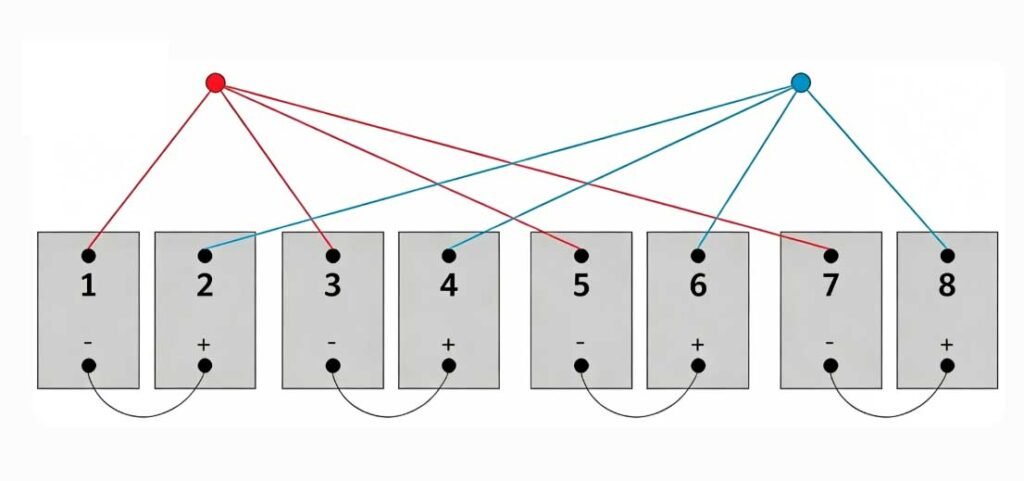
Wiring Method
- String 1: Battery 1 + Battery 2 in series
- String 2: Battery 3 + Battery 4 in series
- String 3: Battery 5 + Battery 6 in series
- String 4: Battery 7 + Battery 8 in series
- Combine all positive terminals together
- Combine all negative terminals together
Result
- Output voltage: 24V
- Total capacity: approximately 4 times a single 24V string
- Best for: high-capacity solar storage, marine systems, commercial backup power, forklifts, utility vehicles
Important Recommendation
The more parallel strings you use, the more important it becomes to keep wiring lengths equal, use proper busbars, install overcurrent protection, and ensure battery matching.
What Gauge Wire to Connect 12V Batteries to Make 24V
Gauge Wire size should be selected based on continuous current, cable length, acceptable voltage drop, temperature rise, and system duty cycle.
| Current Range | Recommended AWG | Approx. Metric Size |
|---|---|---|
| 0–15A | 14 AWG | 2.5 mm² |
| 15–30A | 12 AWG | 4 mm² |
| 30–50A | 10 AWG | 6 mm² |
| 50–80A | 8 AWG | 10 mm² |
| 80–120A | 6 AWG | 16 mm² |
| 120A+ | 4 AWG / 2 AWG | 25 mm²+ |
Wire Sizing Guidance
- Use the same wire gauge for all string interconnects whenever possible
- For long cable runs, choose one size larger to reduce voltage drop
- Always use high-quality stranded copper battery cable
- Avoid ordinary household wire for battery bank connections
Why Wire Gauge Matters
Undersized cables can cause excessive voltage drop, cable heating, reduced system efficiency, and fire risk under high current.
Important Safety Rules for 12V to 24V Battery Wiring
When wiring batteries in series and parallel, safety should always come first.
Best Practices
- Use batteries of the same type, capacity, and chemistry
- Match battery age and state of health as closely as possible
- Measure open-circuit voltage before connecting batteries
- Install a fuse or circuit breaker on the main positive output
- Use properly crimped copper lugs and secure terminals
- Keep cables short, neat, and protected from abrasion
- Provide adequate ventilation and spacing around the battery bank
Lithium Battery Note
If you are building a 24V lithium battery bank, a proper BMS (Battery Management System) is required to protect against overcharging, over-discharging, overcurrent, cell imbalance, and overheating.
Common Mistakes to Avoid
- Mixing old and new batteries
- Mixing different capacities
- Connecting 3, 5, or 7 batteries randomly in a 24V system
- Using wire that is too small
- Skipping fuses or breakers
- Reversing polarity
- Leaving loose terminals
Can 3 12V Batteries Be Used to Make 24V?
In general, 3 batteries are not ideal for a balanced 24V system.
Why?
- 3 x 12V in full series would create 36V, which is too high for a 24V load
- A mixed series-parallel arrangement with an odd number of batteries can create imbalance
- Unbalanced battery banks are difficult to charge and maintain properly
Recommendation: If you want a stable 24V battery bank, always build in even-numbered pairs: 2 batteries, 4 batteries, 6 batteries, or 8 batteries.
Where 12V to 24V Battery Wiring Is Used
This wiring method is widely used in many DC power systems, including:
- RV and camper power systems
- Off-grid solar storage systems
- 24V inverters
- 24V water pumps
- Monitoring and security power supplies
- Marine battery systems
- Forklifts and utility vehicles
- Telecommunication backup power
- UPS battery banks
- Small electric vehicle systems
Why 24V is popular: A 24V system can reduce current compared with a 12V system at the same power level, which often means lower cable losses, smaller voltage drop, and better efficiency for medium-load applications.