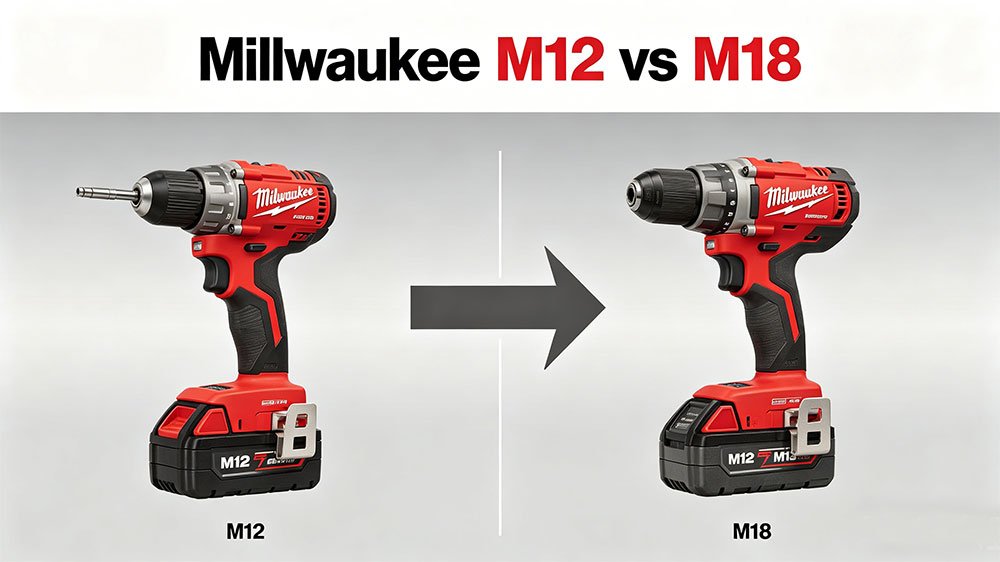
If you are comparing Milwaukee M12 vs M18, the real question is not which platform is “better” in general — it is which one fits your work.
The M12 platform is built for compactness, control, and reduced fatigue. It is ideal for tight spaces, overhead work, service calls, and light-to-medium duty tasks where maneuverability matters more than maximum power.
The M18 platform is designed for higher torque, longer runtime, and heavy-duty jobsite performance. It is the better choice for demanding drilling, fastening, cutting, and continuous use in construction and industrial environments.
If your daily work includes both precision service tasks and heavy-duty applications, many professionals choose to use both M12 and M18 tools as complementary platforms.
Quick Answer: Milwaukee M12 or M18?
Choose Milwaukee M12 if you need a lighter, more compact tool for electrical work, plumbing repairs, cabinet installation, maintenance, and other tight-access jobs.
Choose Milwaukee M18 if you need more power, longer battery life, and better performance for structural work, larger drilling tasks, heavy fastening, and continuous jobsite use.
In simple terms:
- M12 = compact, lightweight, service-friendly
- M18 = powerful, durable, heavy-duty
- M12 + M18 = best combination for mixed trade work
Milwaukee M12 vs M18 Comparison
Here is a practical comparison of the two platforms.
| Feature | Milwaukee M12 | Milwaukee M18 |
|---|---|---|
| Voltage Platform | 12V | 18V |
| Weight | Lighter | Heavier |
| Size | Compact | Larger |
| Power Output | Moderate | High |
| Runtime | Shorter with smaller batteries | Longer with larger batteries |
| Best For | Tight spaces, service work, light-duty tasks | Heavy-duty drilling, fastening, cutting |
| Fatigue Level | Lower | Higher in long handheld use |
| Price Positioning | More affordable entry point | Higher-cost professional platform |
| Tool Ecosystem | Broad compact tool lineup | Broad full-size pro tool lineup |
The main tradeoff is simple: M12 offers better mobility, while M18 offers more output.
Milwaukee M12: Compact Power for Tight Spaces
The Milwaukee M12 platform is designed for users who need a tool that is easier to carry, easier to control, and easier to use in restricted spaces.
This makes M12 especially valuable for:
- electricians
- plumbers
- HVAC technicians
- maintenance workers
- cabinet installers
- furniture assemblers
- DIY users who want a lighter tool system
Why Professionals Choose M12
For service work, compact size often matters more than raw power. A lighter tool is easier to position above shoulder height, inside cabinets, around piping, and in other awkward work areas.
M12 tools are well known for:
- compact body design
- one-handed control
- lower user fatigue
- better access in confined spaces
- lower entry cost
- strong performance for light and medium-duty tasks
For tasks such as pilot holes, light fastening, maintenance removal, and indoor installation work, M12 is often the more efficient platform.
M12 Limitations
M12 is not the best option when the job demands maximum torque or extended runtime under heavy load. Compared with M18, M12 tools generally have:
- less torque reserve
- smaller battery capacity options
- less runtime for demanding applications
- reduced suitability for heavy drilling or structural fastening
If your work regularly pushes tools to their limit, M18 is usually the better fit.
Milwaukee M18: Full-Size Performance for Demanding Jobs
The Milwaukee M18 platform is built for users who need more power, more runtime, and more durability in demanding environments.
This makes M18 a stronger choice for:
- construction work
- concrete drilling
- steel fastening
- heavy-duty installation
- remodeling
- jobsite production work
- high-load professional applications
Why Professionals Choose M18
M18 is the platform you choose when the job requires a stronger torque profile and longer battery endurance. Larger battery packs support longer work sessions, and the platform is designed to handle more aggressive applications.
M18 tools are known for:
- higher torque output
- longer runtime
- larger tool ecosystem
- better support for heavy-duty applications
- stronger suitability for replacement of corded tools in many tasks
For trades that demand power all day, M18 gives you a wider performance range.
M18 Limitations
The tradeoff for that extra capability is size and weight. Compared with M12, M18 tools are generally:
- heavier
- larger in the hand
- more tiring during long handheld use
- more expensive to buy into initially
- less convenient in very tight access situations
If your work is mostly light service or precision installation, M18 may feel like more tool than you need.
M12 vs M18 Tools: Which Platform Fits Your Trade?
When comparing Milwaukee M12 vs M18 tools, the best choice depends on the type of work you do most often.
Choose M12 if you work in:
- electrical service
- plumbing repair
- HVAC maintenance
- cabinet installation
- trim and finish work
- furniture assembly
- small-space installations
- overhead applications where low weight matters
Choose M18 if you work in:
- construction
- framing
- concrete work
- steel fastening
- heavy remodeling
- demolition and cutting
- continuous jobsite applications
- tasks that demand longer runtime and higher torque
A Practical Rule of Thumb
- Access first = M12
- Power first = M18
- Mixed workload = both platforms
M12 vs M18 Milwaukee Drill: Which Drill Should You Buy?
If you are comparing m12 vs m18 milwaukee drill options, think about the material, hole size, and frequency of use.
M12 Drill
A Milwaukee M12 drill is a strong choice for:
- cabinet installation
- light fastening
- service drilling
- small hole work
- indoor maintenance
- tight-access installation work
It is easier to control, lighter to carry, and less tiring over long periods.
M18 Drill
A Milwaukee M18 drill is better for:
- larger hole saws
- thicker materials
- repetitive drilling
- demanding jobsite use
- construction-level fastening
- higher torque applications
It gives you more torque reserve and more runtime when the job becomes more intense.
Drill Selection Summary
If you want better control and portability, choose M12.
If you want more power and endurance, choose M18.
Milwaukee Impact Wrench M12 vs M18
For users comparing Milwaukee impact wrench M12 vs M18, the difference usually comes down to removal power versus compact handling.
M12 Impact Wrench
The M12 impact wrench is ideal for:
- automotive service
- light mechanical work
- maintenance tasks
- frequent tool handling
- jobs where lower weight improves productivity
It is easier to maneuver and less fatiguing in repeated use.
M18 Impact Wrench
The M18 impact wrench is better for:
- seized fasteners
- larger hardware
- structural applications
- higher breakaway torque
- more demanding removal jobs
- heavy-duty mechanical and construction work
If you need maximum fastener removal performance, M18 is usually the stronger choice.
Impact Wrench Selection Summary
- M12 = compact service efficiency
- M18 = heavy-duty breakaway power
M12 and M18: Which Platform Is Better for Overhead Work?
For overhead work, M12 often has the advantage because it is lighter and easier to hold for extended periods.
That matters for:
- ceiling installations
- conduit work
- hanging fixtures
- service tasks above shoulder height
- repeated hand-held positioning
However, if the overhead application also requires high torque or heavier fastening, M18 may still be necessary.
In short:
- M12 = better for comfort and mobility
- M18 = better for power and heavy-duty overhead applications
M12 and M18: Which Platform Is Better for Long Runtime?
If runtime is your main concern, M18 usually wins.
M18 supports larger battery packs, which gives it a clear advantage for:
- extended jobsite use
- repeated drilling and fastening
- long work shifts
- heavy-load applications
- fewer interruptions for charging
M12 can still perform well for light service work, but under sustained load, M18 is the stronger endurance platform.
M12 and M18: Which Platform Is Better for Tight Spaces?
If you are working in confined areas, M12 is the better choice.
M12 tools are generally:
- shorter
- lighter
- easier to position
- easier to manipulate in cabinets, utility spaces, and mechanical rooms
This makes M12 especially useful for electricians, plumbers, installers, and maintenance technicians who frequently work in restricted access environments.
Battery and Charger Compatibility
One of the most important differences between Milwaukee M12 and M18 is that they are separate battery platforms.
Are M12 and M18 Batteries Interchangeable?
No. M12 batteries do not fit M18 tools, and M18 batteries do not fit M12 tools.
Each platform uses its own battery architecture, housing, and electronics. That means the systems are not cross-compatible.
Can M12 and M18 Chargers Be Shared?
In general, M12 and M18 tools use different chargers. Some Milwaukee charging systems may support multiple battery types, but compatibility depends on the specific charger model.
If you already own one platform, it is usually best to stay within that ecosystem unless you have a clear reason to expand into the other.
Which Platform Is Better for Existing Milwaukee Users?
- If you already own M12 tools, expanding M12 is often the most cost-effective move.
- If you already own M18 tools, staying with M18 protects battery compatibility and platform efficiency.
- If you work across multiple trades, a dual-platform setup can be the most practical long-term solution.
Final Verdict: Milwaukee M12 vs M18
The best platform depends on the job.
Choose Milwaukee M12 if you want a lightweight, compact, and easy-to-handle tool system for service work, installations, and tight spaces.
Choose Milwaukee M18 if you need more torque, more runtime, and stronger performance for heavy-duty construction and demanding jobsite applications.
For many professionals, the most effective solution is to use both platforms together:
- M12 for access
- M18 for power
That is the real advantage of the Milwaukee ecosystem.