Choosing the right chainsaw chain type is one of the most important decisions you can make when replacing a worn chain or setting up a saw for a specific cutting job. The right chain improves cutting speed, reduces unnecessary wear, supports safer operation, and helps you get better results with less maintenance.
Different chainsaw chain types are designed for different cutting conditions. Some chains are built for maximum speed in clean wood. Others are made to handle dirty logs, frozen timber, or long-term use with less frequent sharpening. Some are optimized for homeowner safety, while others are designed for professional logging or milling.
This guide explains the main chainsaw chain types, how to match the correct size, how to choose a chain based on your cutting job, and how different brands compare.
Quick Answer Which Chainsaw Chain Type Should You Choose
If you want a fast recommendation:
- For beginners and home use choose a semi-chisel or low-profile low-kickback chain
- For clean hardwood and fast cutting choose a full chisel chain
- For dirty wood frozen wood or mixed conditions choose a semi-chisel chain
- For chainsaw milling choose a ripping chain
- For extreme abrasion resistance choose a carbide-tipped chain
If you are not sure which type to buy, semi-chisel is usually the safest and most versatile choice for most users.
What Chainsaw Chain Types Mean and Why They Matter
Chainsaw chain types are not just different product names or brand labels. They describe the actual cutter design, chain geometry, and intended use of the chain.
The chain type affects several key performance factors:
- Cutting speed
- Kickback tendency
- Sharpness retention
- Sharpening frequency
- Tolerance to dirt and debris
- Comfort and control during cutting
- Overall service life
A chain that performs well in clean lumber may wear out quickly in dirty firewood. A chain that is safe and forgiving for a beginner may feel too slow for professional felling work. That is why choosing the right chain type matters.
In practice, the best chainsaw chain is the one that matches:
- your saw
- your guide bar
- your sprocket
- your experience level
- your wood type
- your cutting conditions
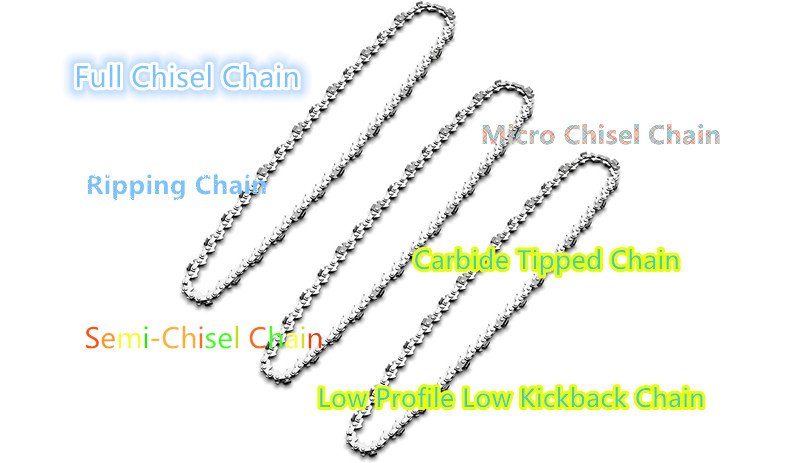
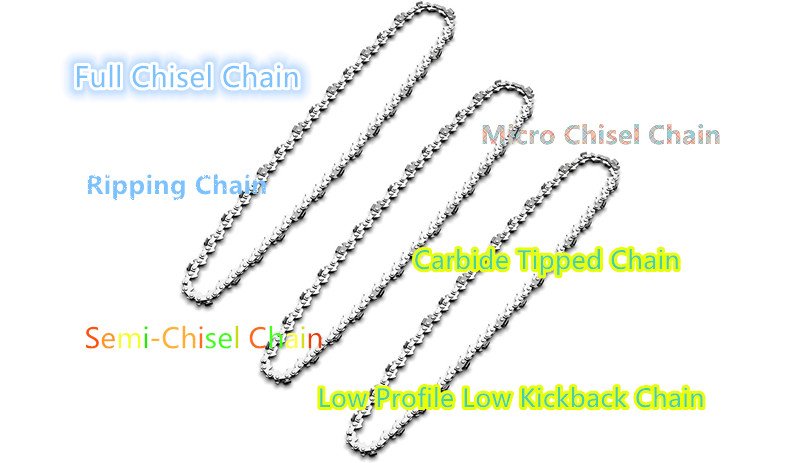
Main Types of Chainsaw Chains
Full Chisel Chain
A full chisel chain uses square-corner cutters designed for aggressive, high-speed cutting. This chain style is built for maximum performance in clean wood and is often preferred by experienced users and professionals.
Best for
- Professional logging
- Clean hardwood
- Softwood
- Felling
- High-output cutting
Advantages
- Fastest cutting speed
- Very aggressive bite in clean wood
- Excellent chip removal
- Ideal for production work
Limitations
- Dulls faster in dirty or abrasive wood
- Less forgiving for inexperienced users
- Higher kickback risk than low-profile chains
Full chisel chains are the right choice when speed matters and cutting conditions are clean.
Semi-Chisel Chain
A semi-chisel chain has rounded cutter corners, giving it a better balance of cutting performance, durability, and ease of maintenance. This is one of the most practical and versatile chain types available.
Best for
- Homeowners
- Firewood cutting
- Dirty or dusty wood
- Frozen wood
- Mixed cutting conditions
- General-purpose use
Advantages
- Better edge retention in rough conditions
- More durable than full chisel
- Easier to sharpen
- More forgiving for most users
- Strong all-around choice for regular use
Limitations
- Slower than full chisel in clean wood
- Less aggressive cutting action
For most users, semi-chisel is the most balanced and dependable chain type.
Low Profile Low Kickback Chain
A low-profile low-kickback chain is designed for safer, more controlled operation. It uses smaller cutters and safety-oriented chain geometry to reduce kickback risk.
Best for
- Beginners
- Homeowner saws
- Battery-powered chainsaws
- Electric chainsaws
- Light pruning and trimming
Advantages
- Lower kickback risk
- Easier to control
- Well suited for small saws
- Safer for less experienced users
Limitations
- Slower cutting speed
- Not ideal for heavy-duty or professional cutting
Low-profile chains are usually the best choice when safety and ease of handling are the top priorities.
Micro Chisel Chain
A micro-chisel chain offers a middle ground between full chisel and semi-chisel. It is designed to deliver a bit more speed than a standard semi-chisel chain while keeping some of the durability benefits.
Best for
- Users who want a balanced chain
- General cutting applications
- Moderate-duty work
Advantages
- Good blend of speed and durability
- More efficient than many standard semi-chisel designs
- Suitable for mixed use
Limitations
- Not as aggressive as a full chisel chain
- Not as tolerant as a semi-chisel in harsh conditions
Micro-chisel chains are a useful option when you want a performance upgrade without moving into a more aggressive and less forgiving chain style.
Ripping Chain
A ripping chain is specifically designed for cutting along the grain. It is used for milling logs, making slabs, and working with chainsaw mills.
Best for
- Chainsaw milling
- Slabbing
- Longitudinal cutting
- Timber processing
Advantages
- Designed for milling applications
- Produces smoother results in along-the-grain cutting
- Better suited to sawmill work than standard cross-cut chains
Limitations
- Not intended for normal cross-cutting
- Poor choice for firewood or felling work
If you are using a chainsaw mill, a ripping chain is the correct choice.
Carbide Tipped Chain
A carbide-tipped chain is a specialty chain built for extreme wear resistance. It is used where normal steel cutters would dull too quickly.
Best for
- Abrasive cutting conditions
- Dirty wood
- Light debris exposure
- Special industrial applications
Advantages
- Very high wear resistance
- Long service life
- Better tolerance to abrasive materials
Limitations
- Higher cost
- Harder to sharpen
- Not necessary for most standard users
Carbide-tipped chains are a niche solution for demanding cutting environments.
Chainsaw Chain Size Guide
Choosing the right chain type is only part of the process. You also need to match the chain dimensions correctly.
Pitch
Pitch is the spacing that defines the chain system and must match the sprocket and guide bar setup.
Common pitch sizes include:
- 1/4 inch
- 3/8 inch Low Profile
- .325 inch
- 3/8 inch
- .404 inch
Gauge
Gauge is the thickness of the drive link that fits into the guide bar groove.
Common gauge sizes include:
- .043 inch
- .050 inch
- .058 inch
- .063 inch
Drive Links
The drive link count determines the actual length of the chain. Two chains can have the same pitch and gauge but different drive link counts.
Important rule
Do not buy by chain length alone. Always confirm pitch gauge and drive link count before ordering a replacement chain.
Choosing the Best Chainsaw Chain by Job Type
The best chainsaw chain depends on the type of work you do most often. The ideal chain for a homeowner pruning branches is not the same as the ideal chain for a logger cutting clean timber or a user operating a chainsaw mill.
Homeowner Use and Yard Work
For light-duty cutting, trimming, and general property maintenance, a low-profile low-kickback chain or semi-chisel chain is usually the best choice.
Why
- Easier to control
- Safer for new users
- Suitable for battery and electric saws
- Good for occasional cutting
Firewood Cutting
For regular firewood work, a semi-chisel chain is usually the most practical option.
Why
- Handles mixed wood well
- Better durability than a full chisel chain
- Easier to maintain over time
- Good balance of speed and service life
If your firewood often contains bark, dirt, or the occasional abrasive log, semi-chisel is usually the better long-term choice.
Hardwood Cutting
For clean hardwood, a full chisel chain often delivers the best cutting speed. If the wood is dirty, aged, or mixed with abrasive material, a semi-chisel chain may be the smarter choice.
Best chain for clean hardwood
- Full chisel
Best chain for dirty hardwood
- Semi-chisel
This is one of the most important distinctions when choosing a replacement chain.
Dirty Wood and Frozen Wood
When cutting dirty, sandy, or frozen wood, a semi-chisel chain is usually the best option.
Why
- Better durability in rough conditions
- Less frequent sharpening
- More forgiving when the wood is not clean
A full chisel chain may cut faster at first, but it will typically lose performance more quickly in harsh conditions.
Professional Felling and Production Cutting
For clean timber and high-output work, many professionals prefer a full chisel chain.
Why
- Highest cutting speed
- Efficient chip removal
- Better performance in clean, production-style cutting
This is the right option when productivity is the priority and the operator is experienced.
Chainsaw Milling
For milling logs into slabs or boards, use a ripping chain.
Why
- Designed for along-the-grain cutting
- Better suited to chainsaw mill setups
- Produces smoother milling results
A standard cross-cut chain should not be used as a substitute for a ripping chain in milling applications.
Chainsaw Chain Brand Comparison Chart
Different brands offer different strengths, but the most important factor is still correct fitment and the right chain type for the application.
| Brand | Positioning | Best Chain Types | Strengths | Compatibility Notes | Typical Use |
|---|---|---|---|---|---|
| Stihl | Premium professional | Micro-chisel semi-chisel low-kickback | Precision durability low vibration | Often best matched to Stihl-specific systems | Pro cutting and high-end homeowner use |
| Husqvarna | Professional and advanced homeowner | Full chisel semi-chisel narrow kerf | Strong cutting performance balanced design | Broad model range with strong system support | Mixed professional and property use |
| Oregon | Universal replacement and wide compatibility | Semi-chisel low-kickback full chisel | Wide availability easy replacement strong compatibility | Often the easiest cross-brand option | General replacement and all-around use |
| Ryobi | Homeowner and battery-powered saws | Low-profile semi-chisel | Lightweight safe practical | Common on smaller bar systems | Light trimming pruning yard cleanup |
| Carlton | Professional forestry | Semi-chisel full chisel ripping narrow kerf | Durability cutting stability pro-grade performance | Built for demanding cutting systems | Logging forestry heavy-duty work |
| Poulan Pro | Home and light professional use | Low-kickback semi-chisel full chisel | Value ease of use broad homeowner fitment | Common in consumer saw applications | General home cutting and occasional firewood |
This chart gives users a fast brand-level overview while helping them understand which chain style is most appropriate for each ecosystem.
How to Match a Replacement Chainsaw Chain Correctly
If you are replacing an existing chain, use the following process to avoid buying the wrong one.
1. Check the guide bar stamp
Most guide bars show the required pitch, gauge, and sometimes the drive link count.
2. Inspect the old chain
If the original chain is still available, check its markings or packaging for the exact specifications.
3. Count the drive links
Drive link count determines the correct chain length.
4. Match the cutter type to the application
Choose the chain style based on how you use the saw:
- full chisel for speed
- semi-chisel for durability
- low-profile for safety
- ripping chain for milling
5. Confirm sprocket compatibility
The pitch must match the sprocket system on your chainsaw.
A chain may look similar to the old one but still be wrong if the size details do not match.
Common Mistakes to Avoid When Buying Chainsaw Chains
Many buyers focus only on chain length and overlook the details that actually determine fit and performance.
Buying by length only
Length is not enough. You must match:
- pitch
- gauge
- drive links
Using the wrong chain type for the wood
A full chisel chain is not ideal for dirty or sandy wood. A semi-chisel chain is usually a better choice in those conditions.
Ignoring kickback risk
Beginners and homeowner users should prioritize safety-oriented chains when possible.
Using a ripping chain for normal cutting
Ripping chains are designed for milling, not standard cross-cutting.
Choosing a chain that is too aggressive for a small saw
Smaller saws usually perform better with low-profile or semi-chisel chains.
Buying low-quality chains
Cheap chains may wear faster, cut poorly, or create unnecessary safety and maintenance problems.
Final Thoughts
Understanding chainsaw chain types helps you choose the right chain for your saw, your cutting environment, and your skill level. The right chain improves cutting speed, reduces maintenance, and makes the saw safer and easier to use.
If you want the most versatile option, choose a semi-chisel chain. If you need maximum speed in clean wood, choose a full chisel chain. If safety matters most, choose a low-profile low-kickback chain. If you are milling lumber, choose a ripping chain.
Before buying, always confirm:
- pitch
- gauge
- RPM (How to Check Chainsaw RPM)
- drive links
- chain type
- saw compatibility
That is the most reliable way to choose the right replacement chain.